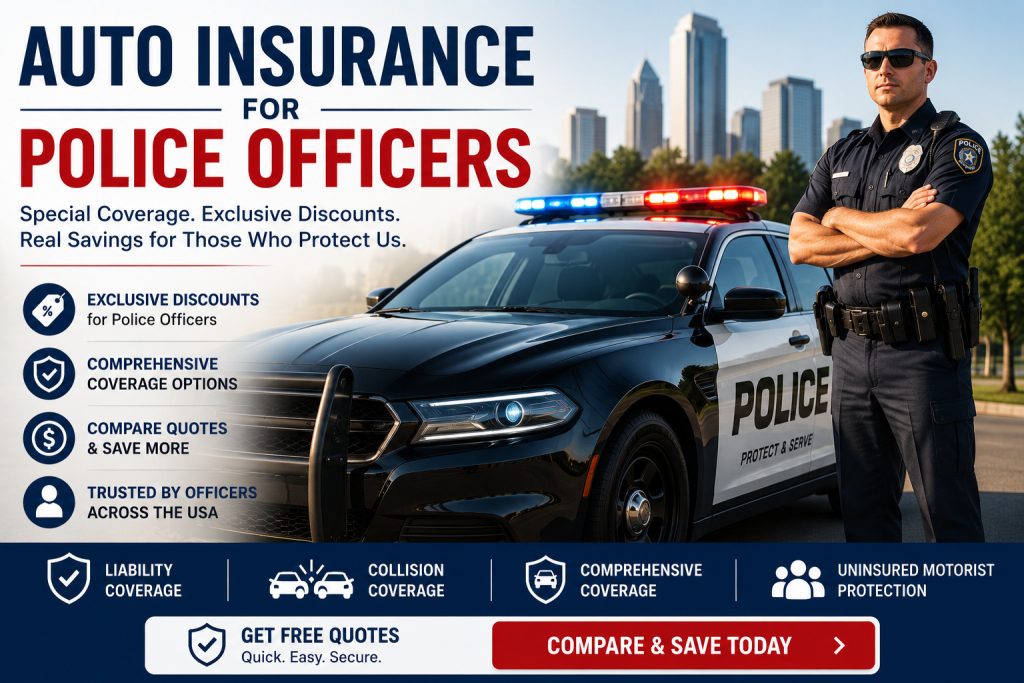

Police officers spend every day protecting the communities. Whether you’re responding to emergencies, working overnight shifts, or commuting to and from the station, driving is part of your daily routine of any Police officer. While your department provides coverage for official vehicles, your personal car still needs the right insurance to protect you and your family.
Many law enforcement professionals wonder if their job qualifies them for lower insurance rates. And some insurance companies do offer discounts for police officers and other first responders, but the answer isn’t always that much straightforward. Every insurer has its own eligibility requirements and your premium depends not on your profession but many other factor.
Your driving history, where you live, the type of vehicle you own, how often you drive and the coverage you choose all play a significant role in determining your insurance costs.
The good news is that understanding how insurers calculate premiums can help you make smarter decisions. Instead of focusing on just one discount, you can compare coverage options, evaluate different insurers and find a policy that offers real value.
In this guide, you’ll learn:
- Whether police officers receive auto insurance discounts
- What coverage options are worth considering
- What affects your insurance premium
- Ways to lower your insurance costs
- How to compare quotes confidently
- Common mistakes to avoid when buying coverage
By the end of this guide, you’ll have a clear understanding of how to choose an auto insurance policy that fits both your budget and your lifestyle.
Do Police Officers Get Auto Insurance Discounts?
Yes, some insurance companies do offer auto insurance discounts for police officers and other first responders. However, these discounts are not available from every insurer, and eligibility often depends on your state and the company’s underwriting guidelines.
Some companies recognize the unique role law enforcement officers play in their communities and may offer occupation-based savings. Others don’t provide a specific police officer discount but may still offer competitive rates through other discount programs.
For example, imagine two officers who live in different states.
Officer A qualifies for a first responder discount through one insurer.
Officer B doesn’t receive an occupation-based discount, but another company offers a lower overall premium because of a clean driving record and low annual mileage.
In this situation, the second officer could end up paying less, even without a police officer discount.
This is why comparing quotes from multiple insurance providers is often more valuable than looking for a single occupation-based discount.
What Determines Whether You Qualify?
Eligibility varies by insurance company, but you may qualify if you’re:
- An active police officer
- A sheriff’s deputy
- A state trooper
- A federal law enforcement officer
- A retired law enforcement professional, depending on the insurer
Some companies may ask for proof of employment before applying the discount.
Even if your occupation doesn’t qualify for a discount, you may still be eligible for savings through safe driving, policy bundling, low mileage, or other programs.
What Is Auto Insurance for Police Officers?
One of the biggest misconceptions is that police officers need a special type of auto insurance and that’s not the truth.
In reality, auto insurance for police officers is the same personal auto insurance available to every driver in the USA.
The difference is that some insurance companies offer additional discounts or benefits for eligible law enforcement professionals.
A standard personal auto insurance policy can include:
- Liability coverage
- Collision coverage
- Comprehensive coverage
- Uninsured and underinsured motorist coverage
- Medical Payments (MedPay)
- Personal Injury Protection (PIP) in eligible states
- Roadside assistance
- Rental reimbursement
- Gap insurance for financed vehicles
Your profession doesn’t change how the policy works. Instead, it may affect whether you qualify for certain discounts or pricing incentives for insurance .
Do Police Officers Need Different Coverage?
Not usually.
Most police officers purchase the same types of coverage as any other driver. The right policy depends on your personal situation rather than your occupation.
For example, if you’ve recently financed a new SUV, you’ll probably want collision and comprehensive coverage to protect your investment.
On the other hand, if your vehicle is older and fully paid off, carrying only liability coverage may make more financial sense.
Your lifestyle also matters.
A detective who drives long distances every week may value roadside assistance and rental reimbursement.
An officer who primarily uses a department-issued vehicle may drive fewer personal miles, making a low-mileage discount worth exploring.
Instead of asking, “What insurance do police officers need?” it’s better to ask, “What coverage makes sense for my vehicle, driving habits, and budget?”
Why Insurance Rates Can Be Different for Every Police Officer
Many people assume that simply working in law enforcement automatically leads to lower insurance rates.
Unfortunately, that’s not how insurance pricing works.
Insurance companies look at a combination of risk factors when calculating your premium. Your occupation is only one small part of the overall picture.
Let’s look at the biggest factors that influence what you’ll pay.
Your Driving Record
Nothing affects your premium more than your driving history.
Insurance companies reward drivers who have a clean record because they’re generally less likely to file claims.
If you’ve avoided speeding tickets, at-fault accidents, and major traffic violations, you’re more likely to receive lower rates.
On the other hand, even if you’re a police officer, multiple accidents or traffic citations can increase your premium.
Safe driving habits often have a greater impact on your insurance costs than any occupation-based discount.
Where You Live
Your ZIP code has a significant impact on your insurance rate.
Insurers consider local risks such as:
- Traffic congestion
- Vehicle theft
- Accident frequency
- Weather-related damage
- Repair costs
- Population density
For example, drivers in large metropolitan areas often pay higher premiums than those living in smaller towns or rural communities because the likelihood of claims is generally higher.
Two officers working for the same department could receive different quotes simply because they live in different neighborhoods.
The Vehicle You Drive
Not every vehicle costs the same to insure.
Insurance companies evaluate several factors before determining how expensive your car will be to cover.
These include:
- Current market value
- Safety ratings
- Repair costs
- Theft rates
- Availability of replacement parts
- Performance and engine size
A reliable midsize sedan with advanced safety technology may cost considerably less to insure than a luxury SUV or a high-performance sports car.
Before purchasing your next vehicle, it’s worth comparing insurance costs along with the purchase price.
How Much You Drive
The more time you spend on the road, the greater your chances of being involved in an accident.
Insurance companies often ask for your estimated annual mileage because it’s one of the factors used to calculate risk.
Many police officers use department vehicles during work hours, which means they may drive their personal vehicles less frequently than the average driver.
If that’s your situation, you could qualify for a low-mileage discount with certain insurers.
Providing an accurate estimate helps ensure your premium reflects your actual driving habits.
Your Claims History
Insurance companies also look at your past insurance claims.
Drivers who have filed several claims over a short period may be viewed as higher risk, even if those claims weren’t all caused by accidents.
Keeping continuous coverage and avoiding unnecessary claims can help maintain more favorable rates over time.
Credit-Based Insurance Scores
In many states, insurers also consider a credit-based insurance score when calculating premiums.
This isn’t the same as your traditional credit score, but it may influence how your insurance rate is determined.
Several states have restrictions on using credit information for insurance pricing, so its impact depends on where you live.
If credit-based scoring is allowed in your state, maintaining healthy financial habits may contribute to more competitive rates.
Why Comparing Quotes Matters More Than Finding One Discount
It’s easy to focus on finding a company that offers a police officer discount.
But that discount alone doesn’t guarantee you will get the best deal.
Imagine this scenario.
One insurance company offers a 5% discount for law enforcement officers, but its base rates are relatively high.
Another insurer doesn’t advertise a police officer discount, yet it offers lower overall premiums because of your clean driving history and low annual mileage.
Even without the occupation-based discount, the second company could save you hundreds of dollars each year.
That’s why experienced insurance shoppers compare multiple quotes with the same coverage limits and deductibles before making a decision.
The lowest premium isn’t always the best value, and the biggest discount doesn’t always lead to the lowest overall cost.
Auto Insurance Coverage Every Police Officer Should Understand
Choosing auto insurance isn’t just about meeting your state’s legal requirements. It’s about protecting yourself from unexpected expenses that could affect your finances for years.
Whether you’re driving to work, taking a family road trip, or running errands on your day off, the right coverage can make a big difference if something goes wrong.
Many police officers spend a lot of time evaluating monthly premiums, but it’s equally important to understand what you’re actually paying for. A policy that costs a little more each month may provide much better protection when you need it most.
Let’s take a closer look at the coverage options available and when each one may be worth considering.
Liability Coverage
Liability insurance is the foundation of every personal auto insurance policy. Nearly every state requires drivers to carry a minimum amount of liability coverage before they can legally operate a vehicle.
If you’re responsible for an accident, liability coverage helps pay for damages you cause to other people.
It can help cover:
- Medical expenses for injured drivers or passengers
- Repairs to another person’s vehicle
- Damage to fences, buildings, or other property
- Legal expenses if you’re sued, up to your policy limits
Many drivers purchase only the minimum coverage required by their state because it keeps premiums lower. While that may satisfy legal requirements, it may not provide enough financial protection after a serious accident.
For example, imagine you’re involved in a multi-vehicle crash that results in extensive injuries and property damage. If your liability limits aren’t high enough, you could be responsible for paying the remaining costs out of your own pocket.
For that reason, many financial professionals recommend choosing liability limits that go beyond your state’s minimum requirements whenever your budget allows.
Collision Coverage
Collision coverage helps pay to repair or replace your vehicle after an accident, regardless of who caused it.
This coverage applies in situations such as:
- Hitting another vehicle
- Backing into a pole
- Sliding into a guardrail
- Rolling your vehicle
- Striking another object
If your vehicle is financed or leased, your lender will usually require collision coverage until the loan is paid off.
Even if you own your vehicle outright, collision coverage may still be worth keeping if replacing your car would create a financial burden.
For example, if your SUV is worth $30,000 and it’s declared a total loss after an accident, collision coverage can help you recover much of that value, minus your deductible.
Comprehensive Coverage
Not every insurance claim involves another vehicle.
Comprehensive coverage protects your car against many unexpected events that happen when you’re not driving or when a collision isn’t involved.
This may include:
- Vehicle theft
- Fire
- Flooding
- Hail damage
- Falling trees or branches
- Vandalism
- Windstorms
- Animal collisions
Suppose you finish an overnight shift only to discover a tree branch has fallen on your parked vehicle during a storm.
Without comprehensive coverage, you’d likely have to pay the repair bill yourself.
For many police officers who park outdoors or live in areas with severe weather, comprehensive coverage provides valuable peace of mind.
Uninsured and Underinsured Motorist Coverage
Even though most states require drivers to carry auto insurance, not everyone follows the law.
Some drivers have no insurance at all, while others carry only the minimum amount required.
If one of those drivers causes an accident, their insurance may not fully cover your losses.
Uninsured and underinsured motorist coverage can help pay for:
- Medical expenses
- Lost wages
- Vehicle repairs in some states
- Other covered damages
Without this protection, you could face significant out-of-pocket expenses because of someone else’s mistake.
Medical Payments (MedPay)
Medical Payments coverage, commonly called MedPay, helps pay medical expenses after a covered accident, regardless of who caused it.
Depending on your policy, MedPay may help cover:
- Ambulance transportation
- Emergency room visits
- Hospital stays
- Surgery
- X-rays
- Follow-up medical treatment
Because MedPay is designed to help with immediate medical costs, many drivers appreciate the extra financial support after an accident.
Availability and coverage limits vary by insurer and state.
Personal Injury Protection (PIP)
Personal Injury Protection, often called PIP, is available or required in certain states.
While MedPay focuses primarily on medical bills, PIP generally offers broader protection.
Depending on your state’s laws, PIP may help pay for:
- Medical expenses
- Lost income while recovering
- Rehabilitation services
- Essential household services
- Funeral expenses in certain situations
If you live in a no-fault insurance state, PIP may play an important role in your overall coverage.
Roadside Assistance
Long shifts, unpredictable schedules, and late-night commutes can make roadside assistance a valuable addition to your policy.
Although it’s optional, this coverage can help when unexpected problems leave you stranded.
Typical roadside assistance services include:
- Battery jump-starts
- Flat tire changes
- Fuel delivery
- Lockout assistance
- Towing to a nearby repair facility
The additional cost is usually modest, and many drivers find it worthwhile for the convenience alone.
Rental Reimbursement Coverage
If your vehicle is being repaired after a covered claim, rental reimbursement coverage can help pay for a temporary rental car.
This coverage can be especially useful if you rely on your personal vehicle for:
- Commuting to work
- Taking children to school
- Medical appointments
- Daily errands
Without rental reimbursement, you’ll need to cover those rental costs yourself while your vehicle is in the repair shop.
Gap Insurance
If you’ve recently purchased a new vehicle with a loan or lease, gap insurance deserves serious consideration.
New vehicles typically lose value quickly during the first few years of ownership.
Imagine your vehicle is totaled six months after purchase.
Your insurance company pays the vehicle’s current market value.
However, you still owe several thousand dollars more on your loan.
Gap insurance may help cover that remaining balance, preventing you from paying the difference out of pocket.
What Does “Full Coverage” Really Mean?
Many drivers ask for full coverage without fully understanding what it includes.
The truth is that “full coverage” isn’t an official type of insurance policy.
Instead, it’s a common term used to describe a combination of coverages.
A full coverage policy usually includes:
- Liability coverage
- Collision coverage
- Comprehensive coverage
Many drivers also choose to add:
- Uninsured and underinsured motorist coverage
- Medical Payments or Personal Injury Protection
- Roadside assistance
- Rental reimbursement
The exact combination depends on your insurer, your state’s insurance laws, and your personal preferences.
How Much Auto Insurance Do Police Officers Need?
There’s no one-size-fits-all answer.
The right amount of coverage depends on several factors, including:
- The value of your vehicle
- Whether it’s financed or leased
- Your state’s insurance requirements
- Your savings
- Your financial goals
- Your comfort level with risk
For example, someone driving a ten-year-old sedan that’s fully paid off may decide liability coverage is enough.
Another officer with a new pickup truck and an outstanding loan will likely want comprehensive and collision coverage to protect that investment.
The key is choosing coverage that matches your financial situation rather than simply selecting the lowest premium.
Coverage Recommendations Based on Your Situation
| Your Situation | Coverage Worth Considering |
| Older vehicle that’s fully paid off | Liability coverage, with optional comprehensive if the vehicle still has meaningful value |
| New financed or leased vehicle | Liability, collision, comprehensive, and gap insurance |
| Daily commuter | Liability, collision, comprehensive, roadside assistance, and rental reimbursement |
| Family vehicle | Higher liability limits, comprehensive, collision, and uninsured motorist coverage |
| High-value vehicle | Higher liability limits, collision, comprehensive, and gap insurance if financed |
These recommendations aren’t universal, but they provide a helpful starting point when comparing policies.
How Much Does Auto Insurance for Police Officers Cost?
One of the most common questions officers ask is, “How much will my insurance cost?”
The honest answer is that there’s no fixed price.
Insurance companies calculate premiums using a combination of personal and vehicle-related factors.
These include:
- Your age
- Driving history
- ZIP code
- Vehicle type
- Annual mileage
- Coverage limits
- Deductible amount
- Claims history
- Available discounts
For example, an officer with a clean driving record, low annual mileage, and a safe family vehicle may receive a much lower premium than someone with recent accidents and a high-performance sports car.
While occupation-based discounts can help reduce costs, they’re usually just one part of the pricing equation.
That’s why it’s important to compare quotes from several insurers using the same coverage limits and deductibles.
Doing so gives you a clearer picture of which policy offers the best overall value, not just the lowest advertised price.
Should You Choose the Cheapest Policy?
A low monthly premium can be appealing, especially when you’re trying to manage household expenses.
However, the least expensive policy isn’t always the best choice.
A cheaper policy may come with:
- Lower liability limits
- Higher deductibles
- Fewer optional coverages
- Limited customer support
- More out-of-pocket costs after an accident
Instead of focusing only on price, compare what each policy actually provides.
Paying a little more each month could save you thousands of dollars if you’re involved in a serious accident or experience a major claim.
The goal isn’t simply to spend less today. It’s to make sure you have the protection you’ll need tomorrow.
Auto Insurance Discounts for Police Officers
Finding affordable auto insurance isn’t just about choosing the company with the lowest advertised rate. It’s about understanding the discounts you may qualify for and making sure you’re comparing policies with similar coverage.
While some insurers offer discounts specifically for police officers, those aren’t the only opportunities to save. In many cases, combining several smaller discounts can reduce your premium more than a single occupation-based discount.
Before you purchase a policy, ask every insurer which discounts are available. The answer may surprise you.
Occupation-Based Discounts
Some insurance companies recognize the service police officers provide and offer discounts to eligible law enforcement professionals.
Depending on the insurer, you may qualify if you’re:
- An active police officer
- A sheriff’s deputy
- A state trooper
- A federal law enforcement officer
- A retired officer, in some cases
Eligibility requirements vary, and not every company offers this type of discount. Some insurers may ask you to verify your employment before applying the savings.
Even if the discount is modest, it’s still worth asking about when requesting a quote.
Safe Driver Discount
Your driving record remains one of the biggest factors that affects your premium.
Drivers who avoid accidents and traffic violations over several years are often rewarded with lower rates.
Maintaining a clean record shows insurers that you’re less likely to file future claims.
To qualify for the best rates:
- Obey speed limits
- Avoid distracted driving
- Maintain continuous insurance coverage
- Drive defensively
A strong driving history can often save more money than an occupation-based discount alone.
Multi-Policy Discount
If you purchase more than one insurance product from the same company, you may qualify for a bundling discount.
Common combinations include:
- Auto and homeowners insurance
- Auto and renters insurance
- Auto and condo insurance
Besides lowering your premium, bundling can also simplify your insurance by placing multiple policies under one account.
Multi-Vehicle Discount
If your household owns more than one vehicle, placing them on the same policy may reduce your overall premium.
This discount is especially helpful for families with multiple licensed drivers.
Instead of managing separate policies, you’ll have one renewal date and one insurance provider.
Low Mileage Discount
Many police officers spend much of their workday driving department-issued vehicles.
If your personal vehicle isn’t driven very often, you may qualify for a low-mileage discount.
Insurance companies generally view drivers with lower annual mileage as less likely to be involved in accidents.
Be honest when estimating your mileage. Providing inaccurate information could create issues if you need to file a claim later.
Defensive Driving Discount
Some insurers reward drivers who complete an approved defensive driving course.
These courses help reinforce safe driving habits and may reduce your premium, depending on your state and insurance company.
Even if the discount is small, the course can improve your driving skills and increase your confidence behind the wheel.
Usage-Based Insurance Programs
Many insurers now offer telematics programs that monitor your driving habits through a mobile app or a device installed in your vehicle.
These programs typically evaluate:
- Speed
- Braking
- Acceleration
- Mileage
- Time of day you drive
Drivers who consistently demonstrate safe driving habits may qualify for additional savings.
Before enrolling, make sure you understand how your driving data will be collected and whether the program could also increase your premium if risky driving habits are detected.
How to Compare Auto Insurance Quotes
Comparing quotes is one of the smartest ways to find affordable coverage.
However, many people make the mistake of comparing prices without checking whether the policies offer the same level of protection .
Follow these steps to make a fair comparison.
Step 1: Gather Your Information
Before requesting quotes, have the following details ready:
- Driver’s license
- Vehicle identification number (VIN)
- Current insurance information
- Estimated annual mileage
- Driving history
Providing accurate information helps insurers generate more reliable quotes.
Step 2: Compare Equal Coverage
This is one of the biggest mistakes shoppers make.
A policy with lower liability limits will almost always cost less than one with higher limits.
For example:
| Policy | Liability Coverage |
| Policy A | $25,000 |
| Policy B | $100,000 |
Policy A may look cheaper, but it also provides much less financial protection.
Always compare policies with the same coverage limits before deciding which one offers the best valu for you .
Step 3: Review Deductibles
Your deductible is the amount you pay before your insurance coverage begins.
Generally:
- Higher deductibles lower your monthly premium.
- Lower deductibles increase your monthly premium.
Choose an amount you could comfortably pay if your vehicle needed repairs after an accident.
Step 4: Ask About Every Available Discount
Don’t assume discounts have already been applied.
Ask each insurer whether you qualify for:
- Police officer discounts
- First responder discounts
- Safe driver discounts
- Multi-policy discounts
- Multi-vehicle discounts
- Low mileage discounts
- Defensive driving discounts
- Good student discounts, if applicable
Small discounts can add up over the life of your policy.
Step 5: Read the Policy Before Buying
Price should never be the only factor in your decision.
Before purchasing coverage, review:
- Liability limits
- Deductibles
- Exclusions
- Optional coverages
- Claims process
- Customer support options
Understanding your policy today can help you avoid unpleasant surprises later.
Practical Ways Police Officers Can Save Money on Auto Insurance
Lowering your insurance premium doesn’t have to mean reducing your coverage.
A few smart decisions can help you save money while still maintaining strong financial protection.
Keep a Clean Driving Record
Safe driving remains one of the most effective ways to qualify for lower premiums.
Avoiding accidents and moving violations can help reduce your insurance costs over time.
Bundle Your Policies
If you also have homeowners or renters insurance, ask whether bundling your policies could reduce your premium.
Many insurers reward customers who insure multiple assets with the same company.
Choose a Vehicle With Good Safety Ratings
Insurance companies often charge lower premiums for vehicles equipped with advanced safety features.
If you’re shopping for a new vehicle, compare insurance costs before making your purchase.
A vehicle with excellent crash-test ratings may cost less to insure over the long term.
Increase Your Deductible
If you have enough emergency savings to cover a larger deductible, increasing it may reduce your monthly premium.
Just make sure the deductible remains affordable if you need to file a claim.
Review Your Policy Every Year
Life changes, and so do your insurance needs.
Review your policy if you’ve:
- Purchased a new vehicle
- Moved to a new ZIP code
- Paid off your auto loan
- Reduced your annual mileage
- Added or removed drivers from your household
A quick annual review can help ensure you’re not paying for coverage you no longer need.
Compare Quotes Before Renewal
Many people automatically renew the same policy every year.
Instead, compare quotes before each renewal period.
Insurance companies regularly adjust their pricing, and another insurer may offer better value for the same coverage.
Spending just a little time shopping around could save you hundreds of dollars each year.
Common Mistakes Police Officers Should Avoid When Buying Auto Insurance
Shopping for auto insurance can feel overwhelming. With so many coverage options, discounts, and insurance companies to choose from, it’s easy to focus only on the monthly premium.
However, the cheapest policy isn’t always the best value.
Avoiding these common mistakes can help you choose coverage that protects both your vehicle and your finances.
Choosing the Cheapest Policy Without Comparing Coverage
It’s tempting to pick the lowest quote, especially if you’re trying to save money.
But a lower premium often comes with lower coverage limits, higher deductibles, or fewer policy benefits.
For example, two policies may differ by only $20 per month. One could include roadside assistance, rental reimbursement, and higher liability limits, while the other offers only basic coverage.
Before making a decision, compare what each policy includes rather than looking at the price alone.
Buying Only the State Minimum Coverage
Every state sets minimum liability limit insurance requirements, but those limits may not be enough after a serious accident.
If damages exceed your policy limits, you could be responsible for paying the remaining costs yourself.
Many drivers choose higher liability limits because they provide greater financial protection without significantly increasing the premium.
Forgetting to Ask About Discounts
Not every discount is applied automatically.
When requesting quotes, ask about:
- Police officer discounts
- First responder discounts
- Safe driver discounts
- Multi-policy discounts
- Multi-vehicle discounts
- Low-mileage discounts
- Defensive driving discounts
Taking a few extra minutes to ask these questions could reduce your annual insurance costs.
Letting Your Coverage Lapse
A lapse in coverage can lead to higher premiums when you purchase a new policy.
Even if you’re switching insurance companies, make sure your new policy starts before your current one ends.
Maintaining continuous coverage shows insurers you’re a responsible policyholder.
Not Reviewing Your Policy Every Year
Your insurance needs can change over time.
A policy that worked well a few years ago may no longer be the best fit.
Review your coverage if you’ve:
- Purchased a new vehicle
- Paid off your auto loan
- Moved to a different ZIP code
- Changed your driving habits
- Added a new driver to your household
A yearly policy review helps ensure you’re paying for the coverage you actually need.
Ignoring Optional Coverages
Optional coverages aren’t necessary for everyone, but they can be valuable depending on your situation.
For example:
- Roadside assistance can help if your battery dies or you get a flat tire.
- Rental reimbursement can keep you on the road while your vehicle is being repaired.
- Gap insurance may protect you if your financed vehicle is declared a total loss.
Think about how you use your vehicle before deciding which optional coverages make sense.
Final Thoughts
As a police officer, you spend your career looking out for others. Your auto insurance should do the same for you.
While some insurance companies offer discounts for law enforcement professionals, those savings are only one piece of the puzzle. The right policy should provide the protection you need at a price that fits your budget.
Instead of choosing coverage based solely on the lowest premium, take time to compare policies, understand your options, and ask about every available discount. A little research today can help you avoid costly surprises down the road.
Whether you’re just starting your career, have years of experience, or are enjoying retirement after serving your community, reviewing your coverage carefully can help you make a confident and informed decision.
The best auto insurance policy isn’t always the cheapest one. It’s the one that gives you the right balance of coverage, value, and peace of mind every time you get behind the wheel.
Frequently Asked Questions
Do police officers get discounts on auto insurance?
Yes. Some insurance companies offer discounts for active or retired law enforcement professionals. However, these discounts vary by insurer and state. When requesting quotes, ask whether the company offers occupation-based or first responder discounts.
Is auto insurance cheaper for police officers?
Not necessarily.
While some insurers provide occupation-based discounts, your premium is influenced by many other factors, including your driving record, age, ZIP code, vehicle type, annual mileage, claims history, and selected coverage.
A clean driving history often has a greater impact on your premium than your profession.
Which insurance companies offer coverage for police officers?
Most major auto insurance companies offer personal auto insurance to police officers. Some may also provide discounts for law enforcement professionals.
Rather than choosing a company based on advertising alone, compare several insurers using the same coverage limits to determine which policy offers the best overall value.
Can retired police officers qualify for discounts?
Some insurance companies extend occupation-based discounts to retired law enforcement officers, while others limit them to active employees.
Eligibility varies, so it’s always worth asking before purchasing a policy.
What type of coverage should police officers consider?
The right coverage depends on your personal situation, but many officers choose a combination of:
Liability coverage
Collision coverage
Comprehensive coverage
Uninsured or underinsured motorist coverage
Medical Payments or Personal Injury Protection
Roadside assistance
Rental reimbursement
Your vehicle’s value, driving habits, and financial goals should guide your decision
Is full coverage worth it?
If you own a newer vehicle, lease your car, or still have an auto loan, full coverage may provide valuable financial protection.
For older vehicles with a lower market value, liability coverage alone may be a more practical option.
Review your vehicle’s value and your financial situation before making a decision.
Does my ZIP code affect my insurance premium?
Yes.
Insurance companies often consider factors such as traffic congestion, accident rates, vehicle theft, weather risks, and repair costs when calculating premiums.
That’s why two officers working for the same department may receive different quotes if they live in different areas.
How often should I compare auto insurance quotes?
t’s a good idea to compare quotes at least once a year or whenever you experience a major life change, such as buying a new vehicle, moving, getting married, or adding another driver to your policy.
Shopping around regularly can help you find better coverage or lower rates.