
Choosing car insurance isn’t just about finding the lowest premium. It’s about making sure you’re financially protected when something goes wrong.
A question of choosing between liability insurance or full coverage car insurance is one of the major challenges that all car owners face. Although both types of insurance are useful to drivers, their functions and implications may vary considerably.
This information may be quite helpful for those who purchase car insurance for the first time, as well as those who want to update their existing policy or decide whether they need to keep full coverage insurance for an old car.
Here we will tell more about the features of both types of insurance and their differences. We will show you when each type is preferable. You will learn how to choose the right policy for your car.
Full Coverage vs. Liability Insurance: What’s the Difference?
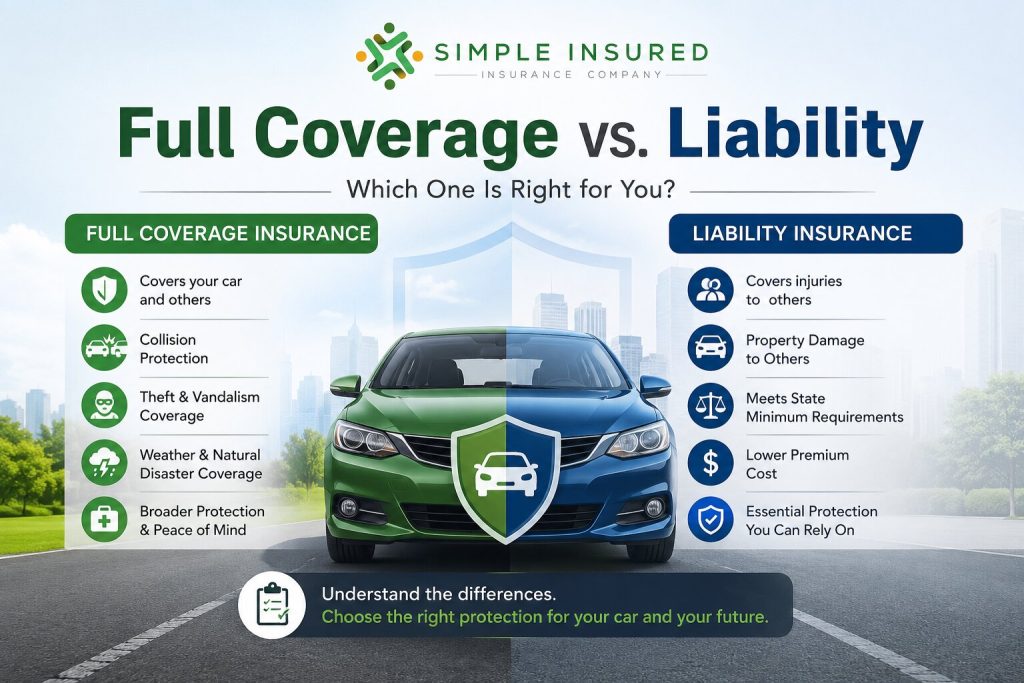
Liability insurance will take care of injuries as well as damage caused by you to other persons. On the other hand, full coverage insurance provides you with liability insurance as well as covers the damages caused to your car.
In case of an accident which is your fault, the liability insurance will be able to compensate for the expenses related to injuries and damage done to another person’s car. But not your own.
The difference between the two lies in collision and comprehensive insurance, which protects the car from various hazards.
| Feature / Protection | Liability Insurance | Full Coverage Insurance |
| Covers injuries you cause to others | ✔ | ✔ |
| Covers damage to another person’s vehicle/property | ✔ | ✔ |
| Covers your own vehicle after an at-fault accident | ✘ | ✔ |
| Covers vehicle theft and vandalism | ✘ | ✔ |
| Covers weather damage (hail, fire, flooding) | ✘ | ✔ |
| Covers animal collisions | ✘ | ✔ |
| Meets state legal minimum requirements | ✔ | ✔ |
| Required by lenders for financed/leased vehicles | ✘ | ✔ |
| Covers medical bills & uninsured drivers | Optional (PIP/UM)* | Optional (PIP/UM)* |
| Relative Premium Cost | Lower | Higher |
While liability insurance satisfies legal requirements in most statesof USA, full coverage provides broader financial protection for your own vehicle ,you and others.
What Liability Insurance Does Not Cover?
Liability insurance is the minimum coverage required in most U.S. states. It protects you financially when you cause an accident that injures another person or damages their property.
A standard liability policy includes two main coverages:
Bodily Injury Liability
Helps pay for injuries you cause to others, including:
- Medical treatment
- Hospital bills
- Lost wages
- Legal expenses
Property Damage Liability
Helps pay for damage you cause to someone else’s property, such as:
- Vehicle repairs
- Replacement costs
- Fences, buildings or other structures
Your policy only pays up to your selected coverage limits. If damages exceed those limits, you may have to pay the remaining costs yourself.
What Liability Insurance Does Not Cover?
Liability insurance does not protect your own vehicle. According to the Insurance Information Institute (III), liability coverage pays for your legal responsibility to others, not your own vehicle repairs or personal losses.
It generally does not cover:
- Repairs to your own car after an at-fault accident
- Theft, vandalism, fire or weather damage
- Your own medical bills or lost income
- Animal collision damage
To protect your own vehicle, you may need collision and comprehensive coverage. Additional coverage options like PIP, MedPay or Uninsured Motorist coverage may provide extra protection depending on your state and policy.
What Does Full Coverage Car Insurance Cover?
Contrary to popular belief, full coverage is not a policy on its own; it is more like a bundle deal.
As reported by the National Association of Insurance Commissioners (NAIC), full coverage does not refer to a particular type of policy but is rather a casual marketing term. Generally speaking, the phrase “full coverage” refers to an auto insurance policy, which combines the following three types of coverages:
1. Liability Coverage: Protects against injury and property damage done to others.
2. Collision Coverage: Protects against damages done to your car when it hits another car, fence, tree, pole, etc.
3.Comprehensive Coverage: Protects against any kind of damages to your car except for collisions (vandalism, fire, flood, theft, animals.
Together, these coverages provide broader protection than liability insurance alone by protecting both your finances and your vehicle.
What Does Full Coverage Car Insurance Not Cover?
Although full coverage car insurance provides broader protection than liability insurance, it does not cover every type of loss.
Most standard full coverage policies do not cover:
- Routine maintenance, such as oil changes and tire replacements
- Mechanical breakdowns or engine failures
- Normal wear and tear caused by regular use
- Personal belongings stolen from inside your vehicle
- Custom parts or modifications unless specifically added to your policy
- Business or commercial use unless included in your coverage
Understanding what full coverage auto insurance does and does not cover helps you avoid surprises when filing a claim. Always review your policy details, deductibles and exclusions to know exactly what protection you have.
Is Minimum Liability Insurance Enough?
Every state sets minimum liability insurance requirements, but those limits aren’t always enough to cover the cost of a serious accident.
For example, if your policy provides $25,000 in property damage coverage and you total a vehicle worth $60,000, you could be responsible for the remaining balance after your insurance pays its limit.
That’s why many drivers choose liability limits above the state minimum. Higher limits can provide better financial protection without significantly increasing your premium.
Cost Difference: Is Full Coverage Worth the Extra Money?
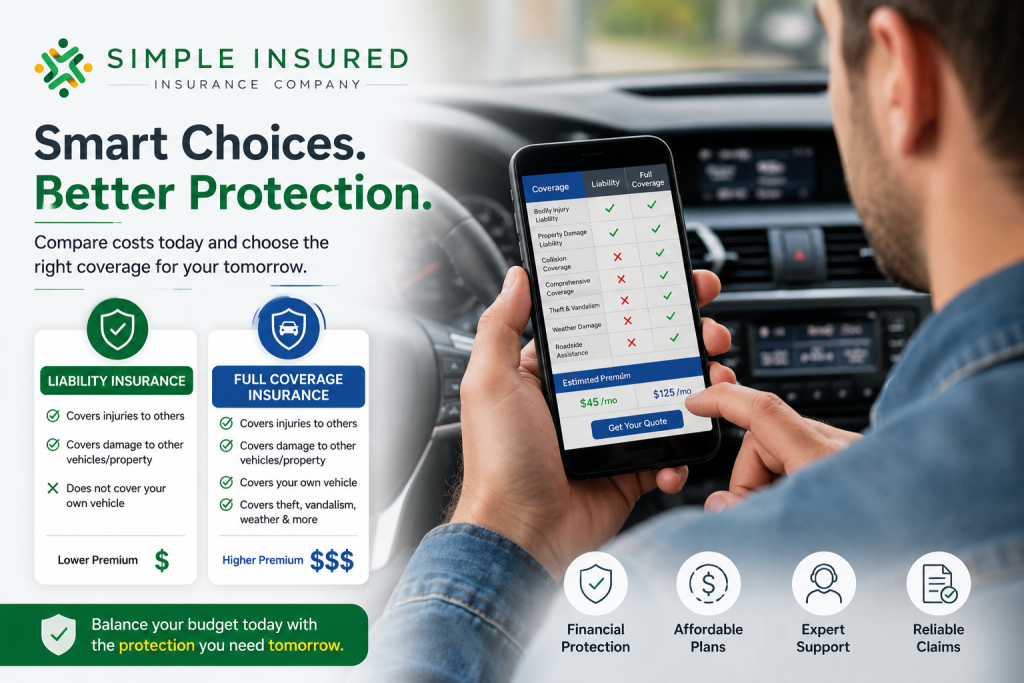
One of the biggest reasons drivers choose liability insurance is the lower your monthly car premium.
Since liability insurance only covers damage and injuries you cause to others, insurance companies take on less financial risk. That generally makes it the more affordable option.
Full coverage costs more because it includes collision and comprehensive coverage, which help pay to repair or replace your own vehicle after covered events.
Although you’ll pay a higher premium, the additional protection can save you thousands of dollars after a major accident, vehicle theft or severe weather damage.
Instead of looking only at the monthly payment, ask yourself one question:
Could I afford to repair or replace my car if it were totaled tomorrow?
If the answer is no, full coverage may be worth the additional cost.
How Much Liability Insurance Do You Need?
Buying liability insurance isn’t just about meeting your state’s legal requirements. It’s about protecting your finances if you’re responsible for a costly accident.
Every state sets minimum liability limits, but those limits may not fully cover medical bills, vehicle repairs or legal claims after a serious crash.
Many insurance professionals recommend carrying higher limits whenever your budget allows.
A commonly recommended coverage level is:
- $100,000 bodily injury liability per person
- $300,000 bodily injury liability per accident
- $100,000 property damage liability
This is often referred to as the 100/300/100 coverage level.
Higher limits can provide better financial protection if you’re involved in an accident that results in significant injuries or property damage.
Factors That Affect the Right Coverage Limit
The amount of liability insurance you need depends on several factors, including:
- The value of your assets
- Your income
- How often you drive
- Local traffic conditions
- State insurance requirements
- Your personal comfort with financial risk
If you own a home, have savings or other valuable assets, higher liability limits may help protect them if you’re sued after an accident.
Who Should Choose Liability Insurance?
Liability insurance can be a practical choice in the right situation.
It may be the better option if:
- You drive an older vehicle with a low market value.
- Your vehicle is fully paid off.
- You could afford to replace your vehicle if it were totaled.
- You’re looking for the lowest possible premium.
- The cost of full coverage is close to your vehicle’s value.
For example, paying hundreds of dollars each year for collision and comprehensive coverage may not make sense if your vehicle is only worth a few thousand dollars.
That said, choosing liability-only coverage means you’ll be responsible for repairing or replacing your own vehicle after an at-fault accident.
Who Should Choose Full Coverage?
Full coverage is often the better choice for drivers who want greater financial protection.
It may be worth the additional premium if:
- Your vehicle is new or relatively new.
- You’re financing or leasing your car.
- Your vehicle has a high market value.
- You depend on your vehicle every day.
- Replacing your vehicle would create financial hardship.
Most lenders require collision and comprehensive coverage until your loan or lease is paid off.
Even if your vehicle is paid for, full coverage can still make sense if replacing it would strain your budget.
When Should You Drop Full Coverage?
Deciding when to drop full coverage comes down to your car’s value and your savings. You should evaluate your policy if your car’s value has dropped significantly, your loan is paid off, or you can afford to replace the vehicle yourself.
To make the call, use the 10% Rule:
The 10% Rule: Subtract your deductible from your car’s market value. If the annual cost of Collision and Comprehensive coverage is 10% or more of that remaining amount, switch to liability-only.
Quick Example:
- Car Value minus Deductible: $2,500 ($3,000 value – $500 deductible)
- 10% Threshold: $250 / year
- Full Coverage Cost: $350 / year
Since $350 is more than 10% of $2,500, dropping full coverage is usually the smarter move. Just remember never to base this decision on your car’s age alone—focus on its actual market value.
Common Mistakes Drivers Make
Choosing the right policy isn’t only about finding the lowest premium. These common mistakes can leave drivers with less protection than they expect.
Choosing Coverage Based Only on Price
A lower premium may save money today, but it could lead to much higher out-of-pocket costs after an accident.
Always compare the auto insurance protection you’re receiving, not just the monthly payment.
Assuming Full Coverage Protects Against Everything
Full coverage provides broader protection, but it still has policy limits and exclusions. Drivers should review their coverage details, deductibles and exclusions to understand what situations are covered before filing a claim.
Review your policy carefully so you understand what’s covered and what isn’t.
Carrying Only the State Minimum
State minimum coverage keeps you legally insured, but it may not be enough after a serious accident.
Higher liability limits can provide stronger financial protection and help reduce the risk of paying large expenses yourself.
Forgetting to Review Your Policy
Your insurance needs change over time.
Review your coverage every year, especially if your vehicle’s value has changed or you’ve paid off your loan.
Choosing a Deductible You Can’t Afford
A higher deductible usually lowers your premium, but it also increases what you’ll pay if you file a claim.
Choose a deductible that fits comfortably within your budget.
Which Coverage Is Right for You?
Selecting between liability insurance and full coverage does not mean going for the least costly plan. One needs to assess the kind of car owned and the financial position before making such a selection.
Liability insurance is sufficient if one has an old car, which has been paid and has relatively a lower price tag. Most motorists choose this kind of insurance plan as it is relatively cheaper and meets the state laws requirements, but one should be ready to bear the expenses of repairs and even total loss if the driver is the cause of the accident.
However, one should have full coverage insurance if he or she has a new car, and the car is either leased or financed. The same is true if one uses his or her car for daily business, which depends on the car. Full coverage insurance plan has a high cost every month, but this helps one from being financially disadvantaged in case his or her vehicle gets damaged or lost.
In deciding, one should compare the annual price of the plan with the market value of the car.
Key Takeaways
- Liability insurance provides coverage for the injuries or damages caused by you to third parties but does not pay for repairing or replacing your own automobile.
- Full coverage includes liability insurance along with collision and comprehensive coverage to cover your vehicle as well as other drivers.
- Liability insurance is generally more convenient than full coverage insurance when you have an older and low-valued vehicle which is fully paid.
- Full coverage insurance is generally better when you have a new and valuable or a financed vehicle since it provides greater financial coverage.
- Having liability limits higher than those required by the state can help you avoid any huge expenses following a severe accident.
- Check your insurance coverage annually to make sure it suits your situation.
Conclusion
The decision of whether to take full coverage insurance or liability insurance is basically determined by three factors; the value of your car, your budget and the kind of financial protection you need. Liability insurance will give you legal cover and it could be enough in case you have an old car which is fully paid for. Full coverage will cost more money but will cover you against any damage or loss to your own car.
Do not rely on the premium alone when choosing an insurance policy. Look at the coverage, deductibles and policy limits to ensure that you get proper insurance. Get car insurance quotes today and find an insurance plan that works for you with Simpleinsured.
Frequently Asked Questions
1. Is full coverage better than liability insurance?
Full coverage is better for financial protection, but liability insurance is better for strict budget savings. Full coverage protects your own vehicle against accidents, theft, and weather damage, while liability only covers damage and injuries you cause to other people.
2. What is the main difference between full coverage and liability insurance?
The primary difference is whose vehicle is protected after an at-fault accident. Liability insurance pays exclusively for the other driver’s medical bills and property damage. Full coverage includes liability insurance plus collision and comprehensive coverages to pay for repairs to your own car.
3. Does full coverage include liability insurance?
Yes, liability insurance is a core component of every full coverage policy. Full coverage is not a standalone policy type; it is a combination that bundles standard state-mandated liability insurance with collision and comprehensive protections.
4. How much liability insurance do I need?
Most insurance experts recommend carrying limits of 100/300/100 rather than state minimums:
$100,000 for bodily injury per person
$300,000 for bodily injury per accident
$100,000 for property damage liability
State minimums rarely cover the full cost of a serious multi-vehicle accident.
5. When should you drop full coverage on an older car?
You should consider dropping full coverage when the annual cost of collision and comprehensive equals 10% or more of your car’s actual cash value. Once a vehicle’s market value drops significantly, paying for full coverage often yields diminished financial returns.
6. Is liability insurance enough for an older car?
Yes, liability insurance is usually enough for older, fully paid-off cars with low market value. If your vehicle is worth less than a few thousand dollars and you have savings to replace it if needed, dropping full coverage keeps your monthly expenses minimal.
7. Can I finance a car with liability insurance only?
No, lenders strictly require full coverage on financed or leased vehicles. Auto lenders require both collision and comprehensive coverage with specific maximum deductibles (usually $500 or $1,000) to protect their financial stake in the car until the loan is paid off.
8. Is full coverage required by state law?
No, state laws only require drivers to carry minimum liability insurance (and sometimes PIP or Uninsured Motorist coverage). Full coverage is never legally required by state governments—it is only required by auto lenders and leasing companies.
9. Does full coverage pay for vehicle theft and vandalism?
Yes, theft and vandalism are covered under the comprehensive portion of a full coverage policy. If your vehicle is stolen, broken into, or vandalized, comprehensive coverage pays for repairs or market-value replacement minus your deductible.
10. Can I switch from full coverage to liability insurance at any time?
Yes, you can drop full coverage at any time if your vehicle is fully paid off. If you own the title outright, you can adjust your policy limits or drop collision/comprehensive through your insurer whenever your financial strategy changes.
11. Does full coverage cover engine failure or mechanical breakdowns?
No, full coverage does not pay for mechanical breakdowns, engine failures, or normal wear and tear. To cover sudden mechanical issues, you need a separate Mechanical Breakdown Insurance (MBI) policy or an extended auto warranty.



Pingback: Top 5 Local Auto Insurance Companies in USA – 2026